
No High Confidence Setup: Why Waiting Is a Valid Crypto Signal Result
Understand why the futures scanner can return no qualified setup, which filters commonly fail and how disciplined waiting helps prevent forced trades.
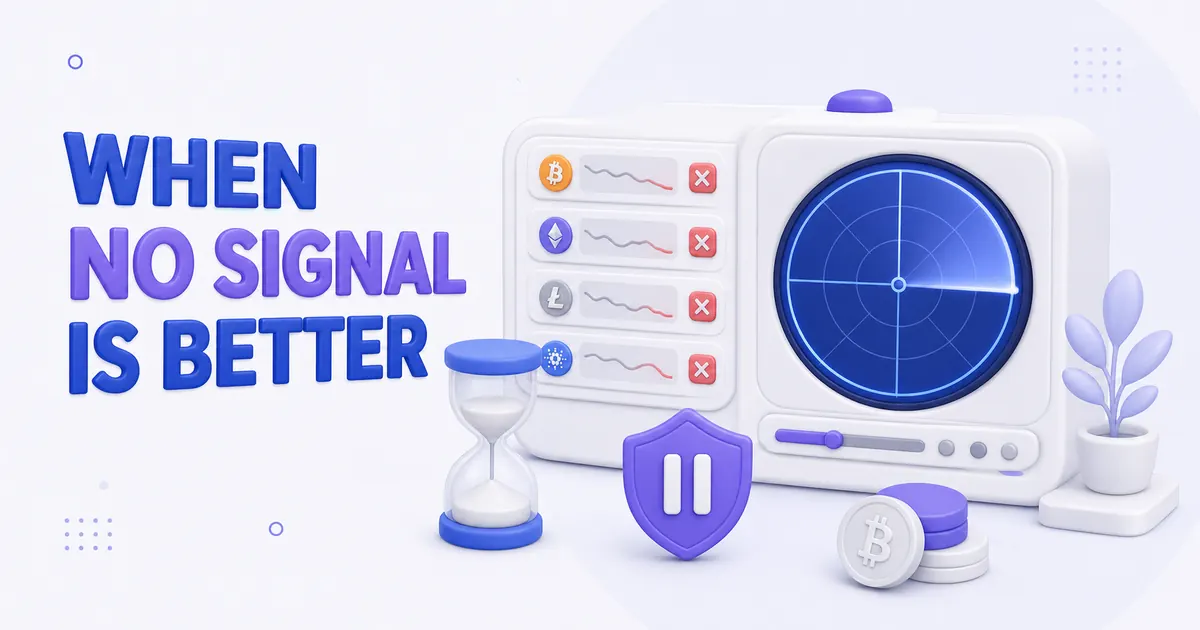
A scanner that always publishes a LONG or SHORT is not necessarily finding opportunity; it may simply be forcing a choice. This application treats No High Confidence Setup as a completed analytical result. It means markets were scanned, evidence was calculated and no candidate satisfied every qualification rule at the same time.
The result can feel unsatisfying when price is moving quickly, but movement and trade quality are different things. This guide explains the filters behind no signal, the difference between waiting for a planned entry and having no qualified candidate, and what users can productively review while the monitor continues.
No signal is not the same as a loading error
During loading, the interface cycles through scanner phases while the server requests and analyzes market data. A temporary data failure produces an explicit availability error. No High Confidence Setup appears only after the scan completes successfully enough to evaluate markets. The card includes the highest score, required score, market condition and number of analyzed contracts.
This distinction matters because refreshing cannot manufacture a different qualified result inside the same signal window. Results are cached by a deterministic window and completed-data cutoff. Repeated refreshes should not turn weak evidence into a signal or give each visitor a random contract.
The score may be below the qualification threshold
The scanner combines weighted 15-minute, 1-hour and 4-hour evidence. A market can have a recognizable trend yet remain below the required setup score because momentum, volume, volatility or structure does not agree. Partial confirmation earns partial points rather than receiving all-or-nothing credit.
The highest displayed score shows how close the leading market came, but a score just below the threshold is still a failure under the configured rules. Rounding is performed only for display, so an internal score cannot qualify merely because its rounded number looks high enough.
LONG and SHORT evidence may be too close
Qualification requires a meaningful directional edge. If bullish and bearish evidence are both strong—or both weak—the setup can be conflicted even when one side technically wins. This is common during volatile ranges, failed breakouts and transitions between broader trends.
Separate scoring prevents the system from pretending that weak bearish evidence automatically creates strong bullish evidence. A market with LONG 70 and SHORT 68 is different from one with LONG 85 and SHORT 20. The first is disagreement; the second has a much clearer directional case.
The 4H market bias can conflict
A fast bullish move inside a strongly bearish 4H environment can produce attractive short-term readings while remaining a risky countertrend trade. The engine applies transparent penalties when the proposed direction conflicts with strong broader bias. The equivalent penalty applies to bearish setups inside strongly bullish 4H structure.
Countertrend trades are not impossible, but the scanner is designed for confluence rather than frequent calls. When the penalty pulls a setup below qualification, no signal communicates that the layers do not agree strongly enough for this framework.
Price may be too extended from a safe zone
A market can score highly immediately after a pump or dump. That is exactly when an entry beside current price can be most dangerous. The entry engine searches confirmed 1H and 4H demand below price for LONG setups and supply above price for SHORT setups. If every qualified zone is beyond the permitted distance, the candidate is rejected.
When a practical zone exists, the scanner may publish the directional setup with WAITING FOR ENTRY. When no practical zone remains, it returns no signal rather than displaying an outdated level. The support and resistance entry guide explains this anti-chasing logic in detail.
Risk levels may fail validation
The structural stop must sit beyond zone invalidation while fitting the permitted 4% or 5% tier. Targets must remain correctly ordered from the reference entry, and TP1 cannot run directly into confirmed opposing structure. A calculation that violates those rules is rejected rather than repaired with arbitrary prices.
Risk reward also comes from the same entry and stop values shown publicly. The scanner does not move the stop inside structure to make the ratio look better. This can eliminate an otherwise strong directional candidate because a good forecast with an incoherent trade plan is not a complete setup.
Insufficient or malformed market data can remove candidates
Each timeframe requires enough completed candles for long-period calculations such as EMA 200 and Ichimoku. New contracts, interrupted data or malformed records may not provide sufficient history. Those markets are excluded from qualification rather than filled with estimated candles.
The engine also validates contract status, quote asset, perpetual type and price filters before analysis. A no-signal card reports how many markets were successfully analyzed, which may be lower than the initial universe when individual data requests fail. The application never substitutes fabricated prices to keep the interface busy.
Market conditions can be mixed without being inactive
High volatility does not guarantee a qualified signal. A rapidly moving range can generate conflicting momentum, extreme RSI, unstable trend readings and poor structural location. Low volatility can create the opposite problem: indicators appear orderly, but target movement and trend quality are too weak.
The market-condition label summarizes evidence from ATR, ADX and directional scores. It helps explain the scan but does not override individual candidate rules. Even a trending market can return no signal if entry or risk validation fails.
What to do while the scanner waits
Use the waiting period to review the indicator interpretations, understand the current market condition and decide what risk is acceptable before a setup appears. Planning while no trade is active is usually clearer than making those decisions during a sudden move. You can also compare the live result with higher-timeframe charts without assuming the next scan must produce a trade.
Avoid repeatedly reopening the site in search of a different answer inside the same window, and do not treat social-media urgency as evidence. The scanner will evaluate completed data again according to its internal schedule. A future result may still be no signal, because qualification depends on markets rather than elapsed time.
Conclusion
No High Confidence Setup is the system honoring its rules. It can reflect weak scores, narrow directional edge, timeframe conflict, unsafe distance, blocked targets, invalid risk or insufficient data. None of those problems is solved by forcing a trade. Waiting preserves capital and keeps the next decision tied to a coherent entry rather than impatience.
Frequently Asked Questions
Does no signal mean the scanner is broken?+
No. A completed no-signal card means the scan ran but no market passed every qualification rule. Data failures are shown separately as errors.
Will refreshing create a new signal?+
Not within the same stable signal window. Refreshing retrieves the current server result rather than generating random alternatives.
Can the highest score be above the threshold with no signal?+
Yes. Direction edge, higher-timeframe conflict, entry distance, structure, targets or stop validation can still reject the candidate.
How long until the next qualified setup?+
There is no guaranteed time. The next scan may find a setup or may correctly return no signal again.
Is WAITING FOR ENTRY the same as no signal?+
No. Waiting means a qualified directional plan exists but price has not reached its structural entry zone. No signal means no candidate passed the full framework.
Apply the Guide to the Current Signal
Review the live contract, higher-timeframe entry zone, position-based targets and entry status.
Support and Resistance Entry Zones: How the Scanner Avoids Chasing Price
How swing reactions, volume, displacement and higher-timeframe structure produce pullback entries instead of post-pump or post-dump chasing.
Read guide
How to Read a Crypto Futures Signal Without Misreading the Setup
A field-by-field explanation of the live signal card, with practical guidance for interpreting entry status, risk levels and technical evidence.
Read guide